
Public Art at CLE: Part 3-The 1990s-2000s

As discussed in Part 1 and Part 2 of this series, Cleveland Hopkins International Airport has displayed a variety of intriguing and sometimes controversial public art pieces throughout its century-long history. In this third and final article, we will examine some of the more recent artworks that have been installed since the 1990s.
Renovated RTA Station (1994)
In January 1992, the Greater Cleveland Regional Transit Authority (RTA) sought input on how to incorporate public art in the renovation of 14 stations on the RTA Red Line, which stretches across Cleveland from Hopkins Airport to Windermere in East Cleveland. Many of the stations were in windswept industrial areas. As an editorial in the Cleveland Plain Dealer put it, “Most of them are at best cheerless, dilapidated relics of other eras.” (May 24, 1994), except for the gleaming new station under Tower City Center downtown that opened in 1990. The planned renovation of the Red Line, which was to last 10 years and cost roughly $104 million, allocated up to $940,000 for public art.
As it neared its 25th anniversary, the historic airport station at CLE appeared quite dingy. This station hosted the launch of North America's first direct rapid transit connection from an airport to the city center, initiated by the Cleveland Transit System (CTS) on November 15, 1968.

The early plans for the airport station were quite uninspiring, focusing primarily on enhancing the walls and lighting. They also included adding benches designed to resemble small-scale versions of the bridges spanning the Cuyahoga River (Cleveland Plain Dealer, January 18, 1992). After some public input, RTA pivoted from this proposed largely cosmetic renovation.
Instead, RTA invested about $1.9 million in improvements to the airport station that include a vaulted ceiling, a skylight, and public art to suit the setting. "We'll have planes going down the runways, planes going down the platform, and planes on each side going all the way down the ramp," Robert Mayer, president of the Cleveland Institute of Art, and chairman of RTA's 20-member Arts in Transit Committee said. "We're making the station a work of art." (Cleveland Plain Dealer, December 30, 1993)
Below are some photos of the remodeled station taken by the author in June 2022.
The renovated station was dedicated on May 14, 1994. Incorporated into the new station’s design is the ceramic art of Angelica Pozo which celebrates Cleveland’s rich flight-related heritage dating back to the 1920’s and the National Air Races, first held in Cleveland in 1929. Entitled Cleveland: Air Laboratory of the World, it consists of clay models of airplanes from the 1930s and later eras placed at intervals along the station walls and repeated in ceramic tiles on the platform floor. The renovated station, as RTA then-General Manager Ronald J. Tober asserted, certainly provides "a warm welcome to visitors using the rapid."
Below are some more detailed photos of Pozo's ceramic work at the station taken by the author in June 2022.
The artist is also known for her public art that graces the Gateway sports complex downtown, home to the Cleveland Guardians Major League Baseball (MLB) club and the Cleveland Cavaliers National Basketball Association (NBA) team. Pozo and Penny Rakoff of Cleveland designed a 30-foot-long concrete tree planter that doubles as a bench. Named Marketplace/Meeting Place: An Urban Memorial, it is covered with sculptures and historical photographs on ceramic tiles, as well as items unearthed in archaeological digs on the Gateway construction site.

Here is a brief biography of the artist from her website, http://www.angelicapozo.com/index.html.

Concourse C-D Connector Tunnel (1999)
Continental Airlines opened its new Concourse D for commuter aircraft on May 16, 1999. It served as the home of the Continental Express operation at the airline's Cleveland hub from 1999 until its closure in mid-2014 after the airline's merger with United Airlines. Arguably, it is the most modern and attractive facility at Hopkins Airport. For a more detailed look at Continental's Cleveland operation and the opening of Concourse D, click here.
Below are some images of the escalators, tunnel and concourse D from the AM Higley Co., taken on May 12, 1999.
Here are some views of Concourse D taken on February 27, 2012. (airlineterminals.blogspot.com)
Gracing the connecting tunnel from Concourse C to D is a whimsical art installation titled Home, School, and Office (1999), created by the artist Andy Yoder. It features large airplanes measuring up to 16 feet in length that resemble being folded from yellow legal paper, newspaper, computer paper, notebook paper, and similar materials, but they are actually crafted from aluminum with photographic laminates.

Here are some additional images of the "paper" airplanes from the sculptural group, Home, School, and Office by Andy Yoder. Photos are courtesy of United Express pilot Chris Belcastro, who took them in June 2014, shortly before the closure of Concourse D.
Cleveland Plain Dealer architecture critic, Steven Litt, wrote the following about the art in the Concourse D connector:
“Like concourses at the big airports in Atlanta and Denver, Concourse D can't be reached directly from the main terminal by an above ground walkway. It's a "midfield" concourse, linked to a point halfway out Concourse C by an 800-foot-long underground walkway with a moving sidewalk inside. The entries to this linkage are marked by 55-foot-high conical towers, with escalators leading down to the moving sidewalk, 30 feet below the jet apron overhead.
"Public art in the towers and the walkway is top quality. New York artist Andy Yoder, a former Clevelander, created four oversized "paper" airplanes, made of aluminum, which dangle from wires in the escalator towers. They strike exactly the right lighthearted note. Inside the underground walkway, Cleveland artist Mark Howard has created a nearly continuous frieze of metal cutout wall panels that evoke propellers, wings and runway attendants serving planes.
"The work enlivens what could have been a monotonous journey between concourses. Everyone involved deserves credit for the public art. Continental footed the $400,000 bill. The city insisted that the artists have local ties and that they be chosen by a panel including local art experts. Shaker Heights art dealer Ernestine Brown oversaw the project.” (Steven Litt, Cleveland Plain Dealer, August 8, 1999)
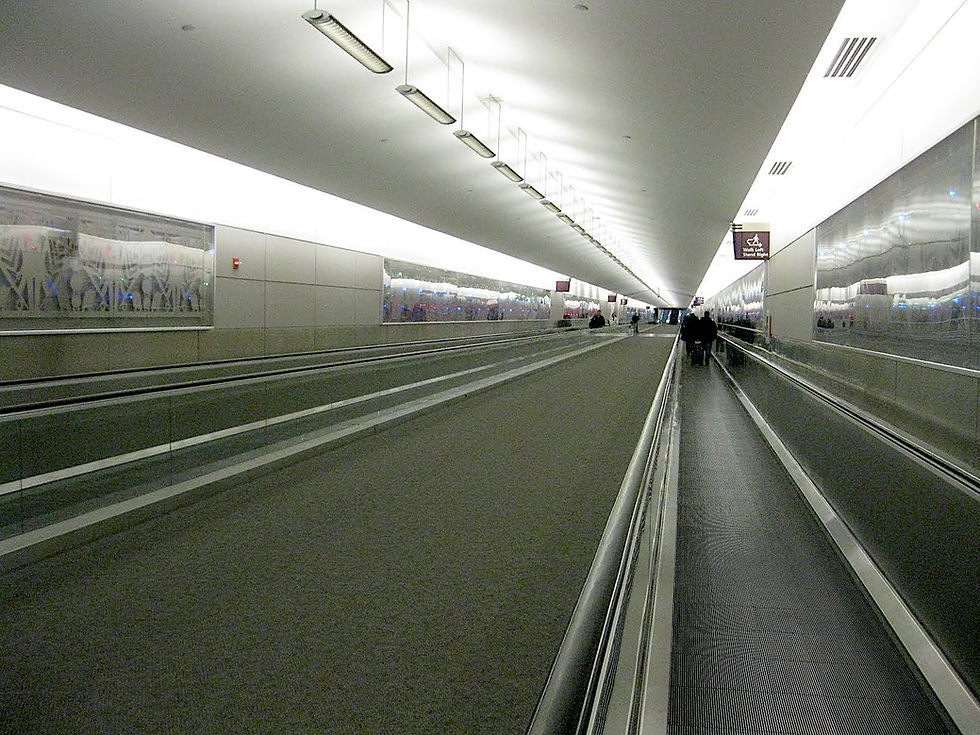

Sadly, after the closure of the United Airlines' Cleveland hub on July 1, 2014, and the subsequent shuttering of Concourse D, these works are no longer accessible to the public and their future fate is currently undetermined. However, there is a glimmer of hope that the giant "paper" airplanes will be rehung in the proposed new terminal announced on May 6, 2025, as part of the Terminal Modernization Development Program dubbed "CLEvolution: The Campaign to Transform Cleveland Hopkins International Airport" https://itsaclevolution.com/.

The CLE Terrazzo Art Project (2014)
In 2011, CLE embarked upon an airport-wide terrazzo installation construction project. In this renovation, 100,000 square feet of carpet was replaced with epoxy terrazzo for durability and ease of maintenance. Work started at the C (now South) security checkpoint, continued up Concourse C, then proceeded to Concourses A and B. The project was completed in January 2014, and on average, it took approximately two weeks to complete each floor section.
As part of this flooring project, 30,000 square feet of vibrantly colorful artwork was infused into the design of the floor, along with 70,000 square feet of a single-color terrazzo. Rather than allowing design consultants to create the entire colored footprint, CLE issued a Call for Artists, seeking local professional and/or amateur artists to submit their renditions of the theme “Cleveland, A Green City on a Blue Lake, past, present & future."
The completed artworks. per the airport's website, “exemplify a physical, structural or dynamic that represents the uniqueness of Cleveland’s past, present or future.” The final seven pieces of art range in size from 6’ x 24’ to 10’ x 50’ and are located throughout the airport, including the entrance of Concourse A and at Gate A5; Concourse B at Gate B6; Concourse C at Gates C1, C10, C14 and C26. The designs of seven Northeast Ohio artists, including a group of high school students, and a TSA officer, transformed Hopkins Airport into a permanent art gallery.
In 2014, Cleveland Hopkins International Airport was recognized with the Honor Award by the National Terrazzo and Mosaic Association (source of the first two photos below, third photo was taken by the author December 4, 2021, and the rest are from the CLE website).
Type City Cleveland (2016)
A partnership with the Cleveland Institute of Art (CIA), this exhibit features artwork using typeface to create images of points of interest in the Cleveland region. Twenty-nine (29) images were installed as part of the terminal renovation prior to the 2016 Republican National Convention held in Cleveland that summer.
Hung above the ticket counters on the upper level of the main terminal, student artists created black on white images of Cleveland landmarks such as the Cleveland Museum of Art, Rock & Roll Hall of Fame and Museum, and Palace Theater, among others, in bold, graphic style through clever arrangements of letters using various typefaces.

Type City Cleveland was begun as a class project in 2007 by Chris Ramsay, then an adjunct professor in the Communication Design (now Graphic Design) department of the CIA. Ramsay tasked juniors with illustrating a city landmark using numerous letterforms to enhance their typography skills. Over time, this assignment created a large portfolio of images, as each student had to choose a new landmark. Vertical images in the series measure 6 by 8 feet; horizontal images are 9 by 6 feet.
Of the 29 installed works, 26 originated from the course-generated images on canvas. Additionally, the Institute commissioned 2012 graduate Kelsey Cretcher to create three new designs. Joshua Werling, the institute's Digital Output Center coordinator, printed the images on canvas. West Shore Frames built the stretcher bars and stretched the canvases, and the airport installed the works. The Cleveland Foundation supported the new installation with a $5,000 grant. Below are a few examples.
2018 Art for the Federal Inspection Station (FIS)
In preparation for the arrival of two air carriers from Iceland in May 2018, and the significant increases in international visitors arriving in Cleveland on WOW and Icelandair’s international service to Reykjavik, Cleveland Hopkins International Airport (CLE) undertook some largely cosmetic renovations of its Federal Inspection Services (FIS) area located on Concourse A. The FIS serves as the U.S. Customs and Border Protection area for arriving international passengers who have not already cleared US Pre-Clearance facilities at the airport of origin (like most Canadian airports, as well as Dublin).
Opened in June 1979, originally with one gate (A14 today) and able to process about 350 passengers per hour, three additional “swing gates” (A9, A11, A12) have been added over the years to accommodate multiple international arrivals as well as domestic flights. The new area was three times the size of the old international arrivals area at the end of the West Concourse (now B) which was last enlarged in 1965.
In late 2017 and early 2018, the airport invested about $175,000 in the two-story space, adding new carpeting, lighting, paint and signage to spruce it up. Here are some photos by Plain Dealer photographer, Marvin Fong, from January 19, 2018, showing the renovated FIS on a tour given by then-Airport Director Robert Kennedy. (Cleveland Plain Dealer, January 25, 2018)
Director Kennedy also wanted to add some locally-focused art on the walls. "We want people to know when they step off that aircraft that they're in Cleveland." To that end, the FIS showcases an exhibit by Cleveland artists Susan Onysko and Paul Duda.
The wall mural, titled Connecting to Cleveland, features photographic images by Duda, and was created by Linear Creative. Duda’s other piece is called The City on the Rise and consists of photos of iconic places in Cleveland.
Onysko's work, named Cleveland Hopkins, Your Window to the World, features examples of her travel photography from all over the world. On the airport's webpage devoted to the images, she stated, "As a travel photographer from Ohio, Cleveland Hopkins International Airport is the springboard to all of my adventures. Travel Photography has been a passion of mine for many years. Whether the United States of America is your home or travel destination, I hope that my images provide inspiration to reach out and explore our magical world." Unfortunately, the airport took down the images and exhibition brochure during its recent website refresh.
The new artwork adds a Cleveland touch and provides a more inviting space for international travelers. Duda commented, “I consider it my life’s work in honor of our beautiful home. As a fourth generation Clevelander, it is a privilege to showcase our land, places and those that have gone before us.”
Conclusion
As the airport states, "Born out of a desire to share the rich artistic talent of Northeast Ohio, the CLE Art Program catches the eyes of millions of visitors each year. Through both temporary and permanent art exhibitions, CLE showcases our creative community by showing work from local creative professionals and art institutions."
New artworks are regularly showcased, and the airport is consistently looking for new artists to enrich the passenger experience. As CLE begins planning for a new landside terminal, public art will undoubtedly play a key role.


This was an informative post with practical details for local residents. I appreciate having a place where different plumbing options are easy to compare. Anyone looking for an Emergency Plumber South Bend should find this page useful when urgent repairs are needed.